

Intel Soars Over 200%: Wall Street Begins Trading the “Post-GPU Era”

Daily Market Read III | Category: Company Read | Date: May 14, 2026
Tiger Capital Research
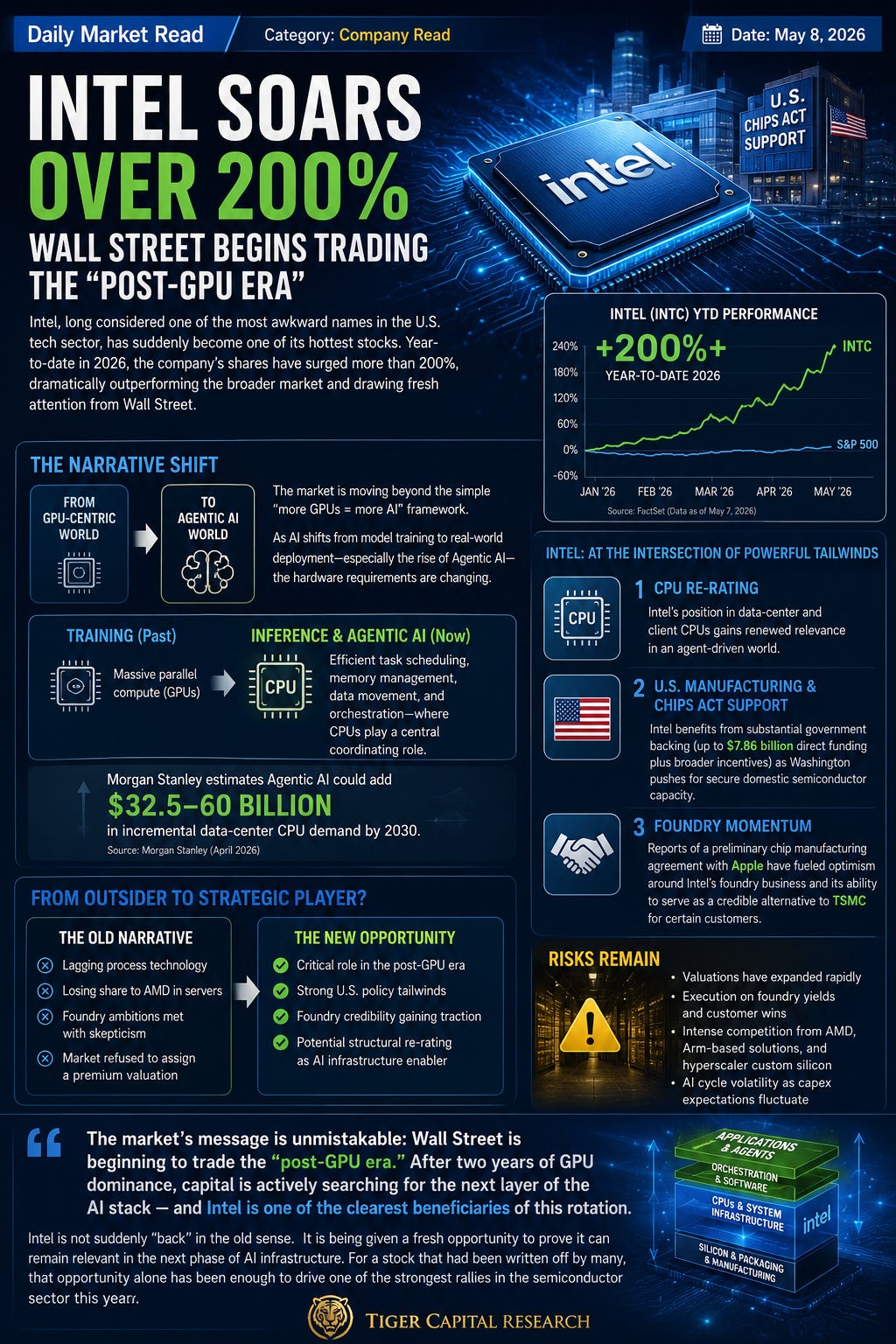
Intel, long considered one of the most awkward names in the U.S. tech sector, has suddenly become one of its hottest stocks. Year-to-date in 2026, the company’s shares have surged more than 200%, dramatically outperforming the broader market and drawing fresh attention from Wall Street.
For years, Intel was viewed as a respected but aging semiconductor giant: strong in legacy PC and server markets but struggling with advanced process technology, losing ground to AMD in servers, and trailing TSMC in foundry capabilities. Its foundry ambitions were repeatedly met with skepticism. The market simply refused to assign it a premium valuation.
That narrative has shifted sharply in 2026. The catalyst is a broader evolution in the AI story. The market is moving beyond the simple “more GPUs = more AI” framework that dominated the past two years. As AI transitions from large-scale model training to real-world deployment: particularly the rise of Agentic AI (autonomous agents capable of multi-step reasoning, tool use, and complex workflows): the hardware requirements are changing. Training favors massive parallel compute (GPUs). Inference and agentic workloads place greater emphasis on efficient task scheduling, memory management, data movement, and orchestration: areas where CPUs play a central coordinating role.
Morgan Stanley recently highlighted that Agentic AI could add $32.5–60 billion in incremental data-center CPU demand by 2030. This shift is prompting investors to re-evaluate companies with strong CPU franchises, advanced packaging, and U.S.-based manufacturing capabilities. Intel sits at the intersection of several powerful tailwinds:
• CPU Re-rating: Its position in data-center and client CPUs gains renewed relevance in an agent-driven world.
• U.S. Manufacturing & CHIPS Act Support: Intel benefits from substantial government backing (up to $7.86 billion direct funding plus broader incentives) as Washington pushes for secure domestic semiconductor capacity.
• Foundry Momentum: Reports of a preliminary chip manufacturing agreement with Apple have fueled optimism around Intel’s foundry business and its ability to serve as a credible alternative to TSMC for certain customers.
These factors are not just about near-term earnings: they represent a potential structural repositioning of Intel from a “legacy chipmaker” to a strategic player in America’s AI infrastructure base. Of course, risks remain significant. The stock has rallied sharply and valuations have expanded rapidly. Execution on foundry yields, sustained customer wins, and competition from AMD, Arm-based solutions, and hyperscaler custom silicon will be critical tests ahead. The AI cycle itself could see volatility as capital expenditure expectations fluctuate.
Still, the market’s message is unmistakable: Wall Street is beginning to trade the “post-GPU era.” After two years of GPU dominance, capital is actively searching for the next layer of the AI stack: and Intel is one of the clearest beneficiaries of this rotation.
The company is not suddenly “back” in the old sense. It is being given a fresh opportunity to prove it can remain relevant in the next phase of AI infrastructure. For a stock that had been written off by many, that opportunity alone has been enough to drive one of the strongest rallies in the semiconductor sector this year.
Tiger Capital Research